They all look about the same, standing at attention in their platoons of twelve, and the cartons don't tell you much. How can you know whether the eggs you are about to buy are fresh and have come from healthy chickens, or are old and have come from poorly fed, stressed birds? The only way to know is to look closely and ask questions.
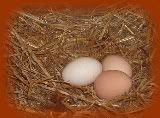
First, how do the eggs look? The shells should be dull, not shiny. Look at the air sacs on the shell's surface: the bigger the air sac the older the egg. The eggs should feel strong, not so delicate that regular handling threatens to crack them.
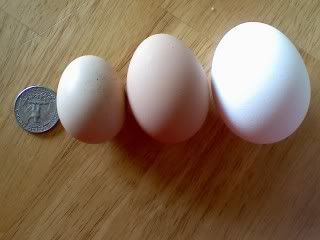 Once you get them home you can perform two more freshness tests: Place the eggs in a large bowl of cold water; if they float, they are quite old. Unshelled onto a plate, the yolk of a truly fresh egg will dome up and stay up, and the white will clearly be thicker in the middle part, thinner on the edges. The yolks should also be a deep yellow orange, not pallid. Another test is to break the egg into boiling water--the so-called water poach. If the egg stays together, it's a good one. Most supermarket eggs break up into tiny pieces on contact with the water.
But how the chickens are treated is the big question. It's best to bypass the cheap, supermarket brand egg. These are usually produced in vast factory "farms" with upwards of 500,000 birds in one facility. The birds are caged in buildings that are artificially lighted and ventilated. The feed is most likely a mixture of conventionally grown corn and soy, undoubtedly contaminated by GMOs and laced with antibiotics. There is not much goodness in eggs like these. More about difference in egggs.
Then there are the smaller, commercial operations that produce free-range, antibiotic-free eggs. These are certainly a step up, but living conditions vary considerably--some producers have their birds on pasture, some give the birds access to the outdoors, some don't; some keep a few roosters, some have none; some keep the groups small, most don't.
If you seek out eggs from a small local grower, consider asking the following questions to learn more about the eggs you buy:
What do you feed your chickens? The ideal feed is a combination of organically grown grains, legumes, grasses, greens, worms and insects. Less than ideal but still acceptable to many is organic lay pellets and organically grown corn and soy. At the bottom of the heap are commercial lay pellets, conventionally grown corn and soy and cottonseed meal.
Do you use antibiotics? If the health of a whole flock is threatened, then the judicial use of antibiotics can usually be tolerated by the consumer, as long as eggs from that period are not sold. Antibiotics routinely added to the feed ration, however, must be strictly avoided.
How many birds do you have? How many chickens in the whole operation, and how many in each flock? Smaller is better. Even with a big operation, if small flocks are maintained--maximum 100 to 150--then the chickens can maintain a chicken society (a pecking order) and will be less stressed.
What are living conditions like for the birds? Do the birds have regular access to the outdoors? What is the square footage of their house and yard? If chickens are given enough space, they are less likely to become stressed and/or diseased.
How fresh are these eggs? Small producers sometimes store eggs for a period of days or weeks until they have enough to make a delivery. Eggs should not be older than 10 days when they are brought to market, and should be labeled with date of harvest.
Are the eggs fertile? What is the ratio of roosters to hens? Anywhere between 1 to 10and 1 to 20 is a good balance. If the producer keeps roosters, the flocks will better resemble a natural chicken society and the hens will be less stressed.
What breed are your chickens? While this likely doesn't matter much to individual egg quality, it gives the consumer an idea of how much the producer knows about his birds.
May I visit your farm? While you might never do this, the producer's response will give you an idea of whether he or she is proud of the operation or ashamed of it.
Surprise source of vitamin D.
 Little Spa
My Whole Food Nation website. Good Food Making You Fat Video w/Dr. Heidi
Email Robin Here


